

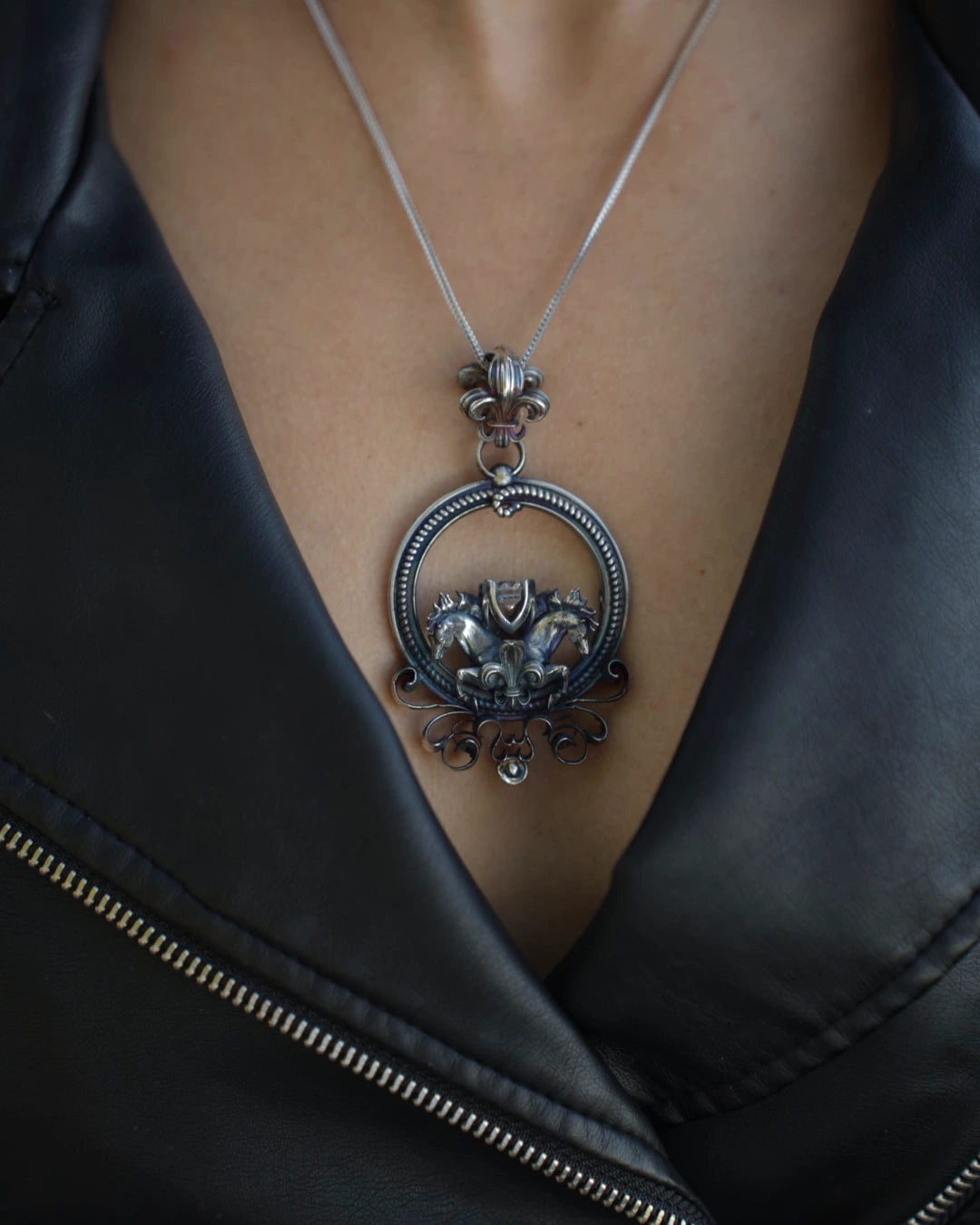
Few images from Greek myth have flown as far as Pegasus. A white horse with wings appears on ancient coins, on coats of arms, in constellations and in a hundred logos. Behind the familiar image is a stranger, darker and more interesting story, and it is the one behind our Immortal Pegasus Pendant.
Born from Medusa
Pegasus did not come from the sky. He came from a monster. When the hero Perseus cut off the head of Medusa, the Gorgon whose gaze turned people to stone, two beings sprang from her: the warrior Chrysaor and the winged horse Pegasus.
It is one of the oldest ideas in myth, and one of the most hopeful. Something free and beautiful can be born from the darkest moment. The poet Hesiod tied his name to the springs of the Ocean where he was born; from the start, Pegasus belongs to water, to air and to beginnings.
The spring of the Muses
On Mount Helicon, the home of the Muses, Pegasus struck the rock with his hoof and water rose from it. The spring was called Hippocrene, the horse's fountain, and the Greeks believed that whoever drank from it received the gift of poetry.
That is why, for centuries, Pegasus has been the emblem of inspiration: the force that lifts an idea off the ground and gives it wings. For anyone who makes things, a sculptor included, it is a fitting companion.
Bellerophon and the golden bridle
No one could ride Pegasus until the young hero Bellerophon prayed to Athena. The goddess gave him a golden bridle, and with it he found the horse drinking at a spring in Corinth and tamed him.
Together they did what no one else could. They flew against the Chimera, a fire-breathing creature with the head of a lion, the body of a goat and a serpent for a tail, and defeated it from the air.
The fall
Success changed Bellerophon. Proud of his victories, he decided he belonged among the gods and rode Pegasus toward Mount Olympus. Zeus sent a gadfly to sting the horse; Pegasus reared, and Bellerophon fell back to earth, where he spent the rest of his life wandering alone.
Pegasus kept flying. He reached Olympus, carried the thunderbolts of Zeus, and was finally set among the stars, where the constellation Pegasus still rises every autumn in the northern sky.
The lesson the Greeks drew is clear: the wings belonged to the horse, not to the rider's pride. Freedom and inspiration are gifts to be carried with care, not used to climb over others.
What Pegasus means today
Out of all that, three ideas have lasted:
- Freedom: a horse that cannot be held by any fence, only by trust.
- Inspiration: the spring of the Muses, the idea that lifts off.
- Renewal: something luminous born from the darkest moment.
The pendant takes the winged horse straight from the myth: a creature born in the darkest moment that still rises toward the stars. It is made for anyone who has turned something hard into the strength to keep going.
The Immortal Pegasus Pendant
Inside a roped ring, two horses face a fleur-de-lis, with a moissanite to catch the light. It is a way to carry the myth close to the chest, every day. Like all our pendants, it is sold on its own, without a chain, so you can wear it on the chain or cord you prefer.
It is solid 925 sterling silver, made to order in 1–2 weeks in the United States, and ships free within the U.S. with its certificate of authenticity.
A myth worth carrying
Pegasus is not a symbol of escape. It is a reminder that what lifts us comes from what we have been through, and that the higher we fly, the more care the flight deserves.
