

Memento mori is a Latin phrase usually translated as "remember that you will die." It sounds grim, yet for most of its history it has worked as an invitation to live with more attention. The skull, the hourglass and the wilting flower that carry the message have been painted, carved and worn for centuries. This guide explains where the phrase comes from, what the symbol means, how artists and jewelers have used it, and how the Memento Mori Skull Ear Tunnel carries it today.
What does memento mori mean?
Memento is a command, "remember," and mori is the verb "to die." The phrase addresses everyone equally. No rank or wealth changes the end, which is a large part of why the reminder has lasted so long.
Where does memento mori come from?
Rome
Tertullian, writing around the year 200, describes a slave standing behind a victorious general in his triumph and whispering, "Look behind you, and remember you are only a man." The words memento mori are not in his account, but the story is often retold as the origin of the idea.
The Stoics
Stoic philosophers such as Seneca, Epictetus and Marcus Aurelius wrote about keeping death in mind as a way of using time well. For them the reminder was practical. If time is limited, it should not be spent on what does not matter.
Medieval Christianity
In medieval Europe the Church made the reminder central. Life is short, so the soul should be ready. After the Black Death in the middle of the fourteenth century, images of death spread through churches and manuscripts, among them the danse macabre, in which skeletons lead people of every rank to the grave.
What does the memento mori symbol stand for?
Time is short
The hourglass, the clock and the burning candle all say the same thing. Time runs out, and nobody sees the last grain fall.
Death comes to everyone
In the danse macabre the king and the beggar dance with the same partner. A skull has no face and no rank, which is why it fits everyone.
Living with intention
This is the Stoic reading and the one most people take from the phrase today. Remembering that life is finite is a way to choose what deserves attention.
The vanity of worldly things
Seventeenth-century Dutch painters such as Pieter Claesz made vanitas still lifes, with a skull among books, coins, instruments and a half-peeled lemon. The message is that learning, money and pleasure do not last.
Memento vivere
Some people now pair the phrase with its counterpart, memento vivere, "remember to live." The two halves belong together, because the reminder of the end gives the days their weight.
The skull in art and literature
The skull is the most direct memento mori image. Hans Holbein's The Ambassadors (1533) stretches one across the floor in front of two wealthy men, visible only from the side. In Hamlet the prince holds the skull of the jester Yorick and thinks about what is left of a laugh. Different periods, one idea: the skull looks back at whoever looks at it.
Memento mori jewelry
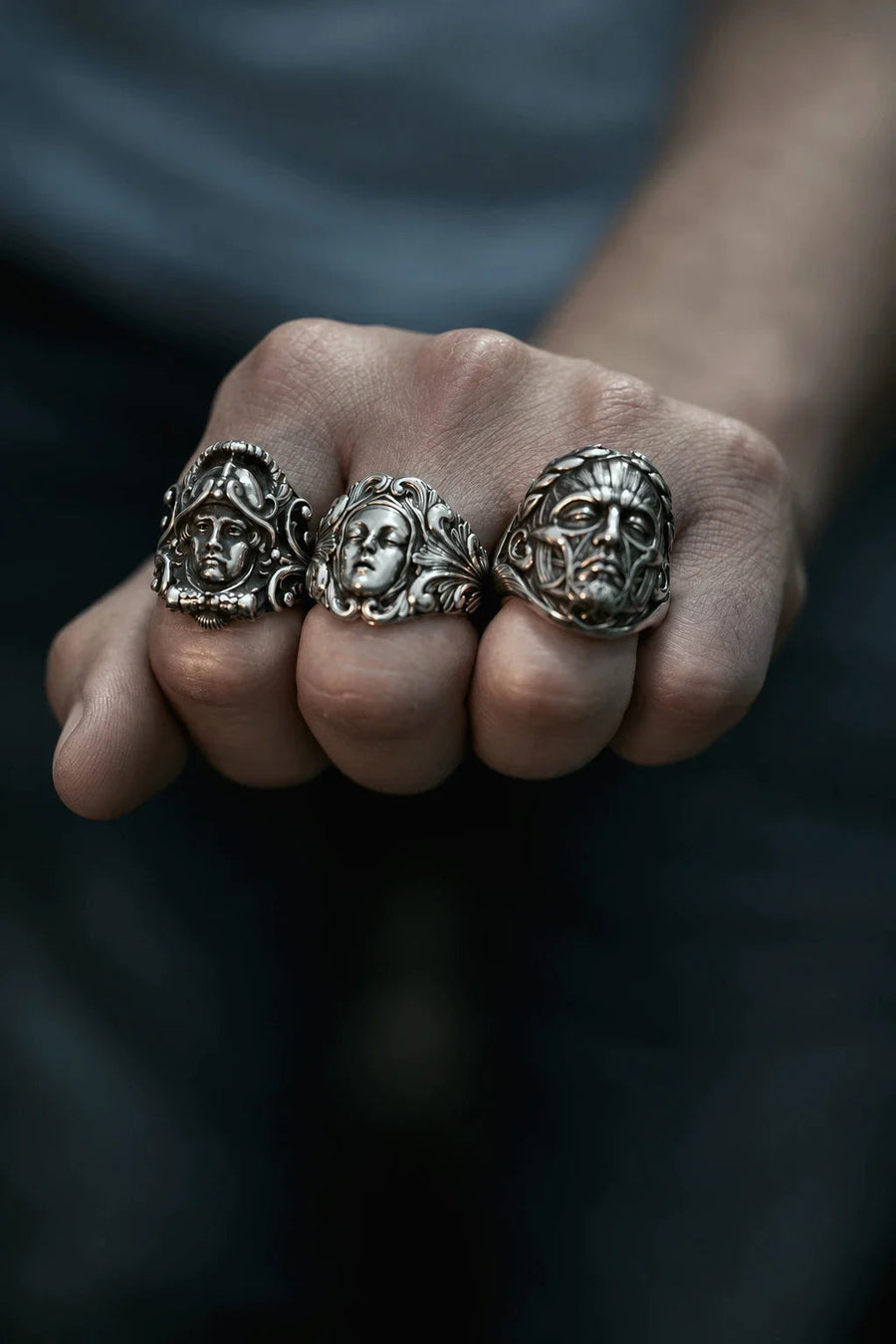
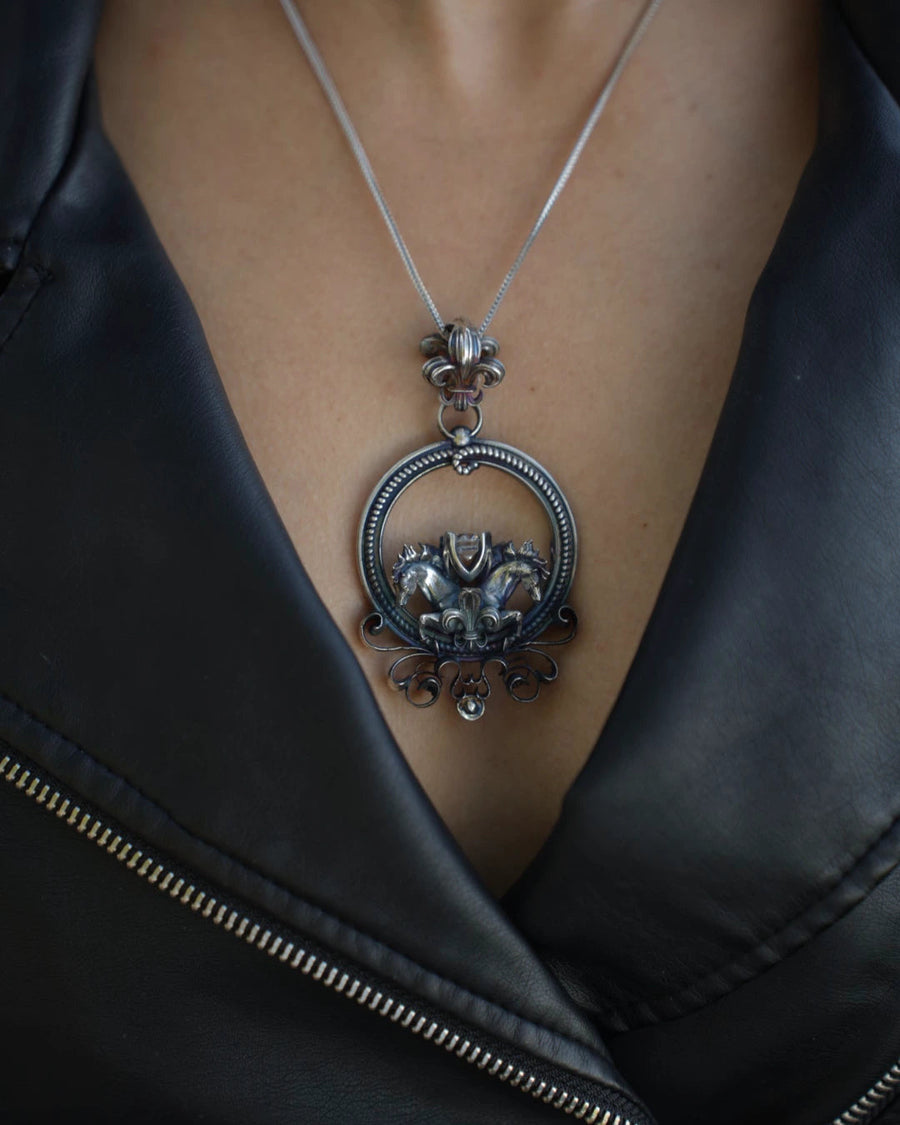
From the sixteenth century, memento mori jewelry was a genre of its own, with rings, pendants and brooches shaped as skulls or coffins, sometimes engraved with the words memento mori. Mourning rings, given at funerals or left to friends in wills, often carried a skull as well. Wearing one kept the reminder close to the body, private for the wearer and readable for anyone who looked closely.
The Memento Mori Skull Ear Tunnel
The Memento Mori Skull Ear Tunnel brings that tradition into a modern piece. A skull with two curved horns sits in relief inside a circular frame of scrolling ornament, and oxidized contrasts bring out the depth of the carving. It is cast to order in solid 925 sterling silver, not plated, and finished by hand, for healed, already stretched ears, in sizes from 12 to 25 mm. It is part of The Dark Veil, our collection of oxidized silver. For a ring on a related theme, the descent into the underworld, see the Catabasis Ring.
Questions
What does memento mori mean?
Latin for "remember that you will die," a reminder that life is finite.
Where does memento mori come from?
The idea is ancient. It appears in Stoic philosophy and in the story of the Roman triumph, and it became central to medieval Christian art.
What does a skull symbolize in memento mori?
The shortness of life and the fact that death comes to everyone, whatever their rank or wealth.
Is memento mori a negative idea?
It depends on the tradition. Christian art used it to call people to repentance, while the Stoics and many people today use it to focus on what matters.
Is the Memento Mori Skull Ear Tunnel unisex?
Yes. The design is unisex.
Is it solid silver?
Yes. It is solid 925 sterling silver, not plated.
How do I choose my size?
Measure the thickest part of a tunnel that already fits you comfortably, with calipers, and choose that size in mm. The piece is made to your measure and cannot be resized.
How long does an order take?
Each piece is made to order, with 1 to 2 weeks of production and then 3 to 5 business days of shipping within the USA. U.S. shipping is free.